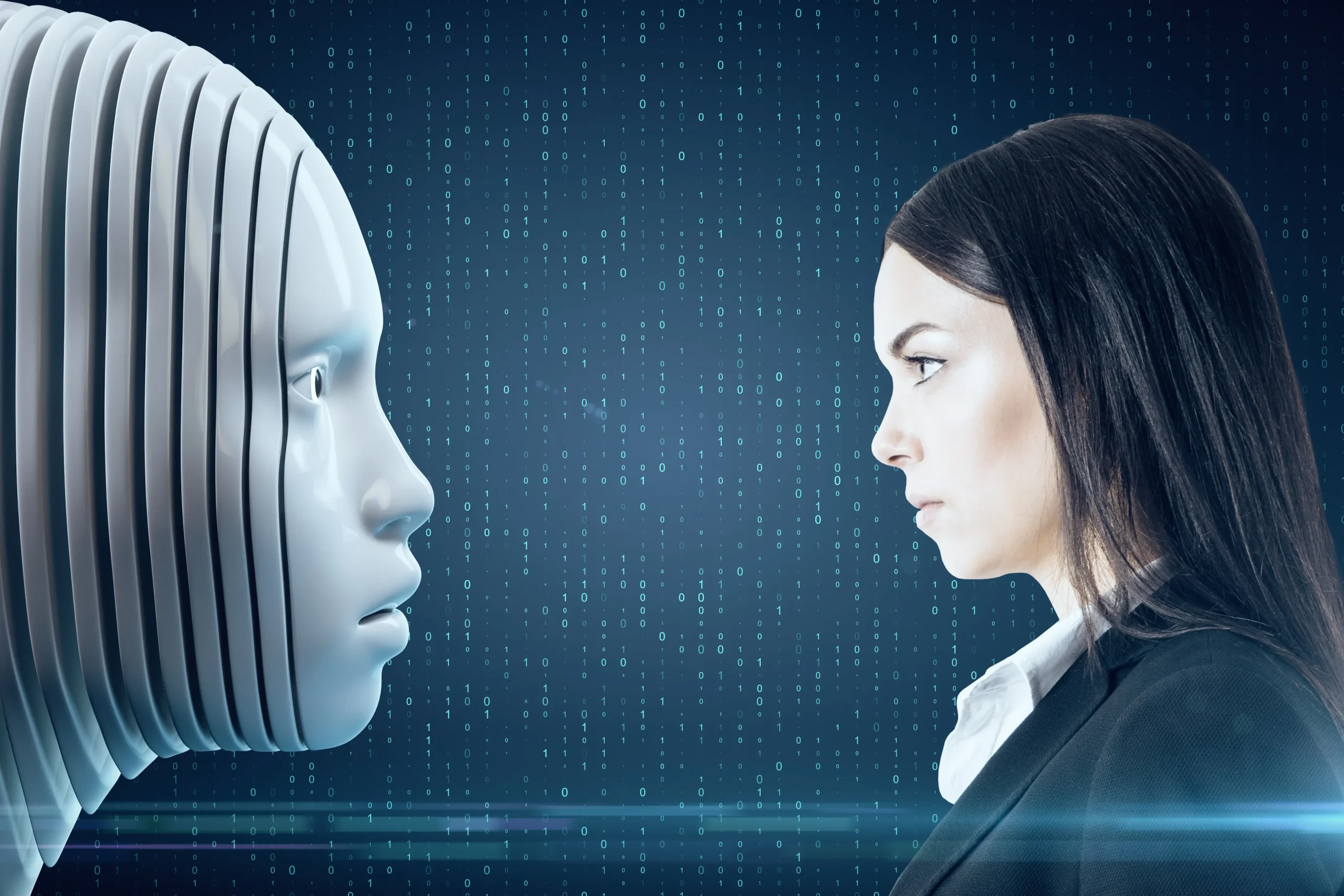
Nowadays, in the era of a fast-changing digital world, the AI vs human intelligence explained is one of the most discussed issues in the technological sphere. Artificial intelligence is transforming industries faster than ever before, whether it is self-driving cars or intelligent chatbots. Meanwhile, the human mind has still been unsurpassed in terms of creativity, empathy, and complicated thinking.
At the beginning of 2026, it is important to define the differences between these two types of intelligence. In this article on Technogater, their essential features, advantages, disadvantages, and the future will be disaggregated.
You may be a tech fan, in business, or a student, but with the help of this all-inclusive guide, you will have a clear picture of what AI and human intelligence mean in a professional and practical sense.
AI vs. Human Intelligence: Side-by-Side Comparison
Before getting into the details, here is a quick side-by-side look at how artificial and human intelligence stack up across the dimensions that matter most in 2026.
| Dimension | Artificial Intelligence | Human Intelligence |
|---|---|---|
| Processing speed | Analyzes millions of data points per second; can scan entire datasets in seconds | Limited by neural signal speed; excels at rapid pattern recognition in familiar contexts, slower on novel large-scale data |
| Learning style | Requires large labeled datasets or reinforcement signals; retrains rather than truly “understands” | Learns from a handful of examples, transfers knowledge across unrelated domains |
| Creativity | Remixes and extrapolates from training data patterns; can produce novel combinations but lacks lived experience | Draws on emotion, memory, and lived experience to originate genuinely new ideas |
| Emotional intelligence | Can simulate empathetic language but has no subjective experience or feeling | Reads context, tone, and unspoken cues; forms genuine emotional connections |
| Error correction | Consistent on well-defined tasks but can fail confidently on edge cases (“hallucination”) | Makes more random errors but self-corrects using judgment and common sense |
| Energy use | Large models run in data centers drawing megawatts of power for training and inference at scale | The human brain runs on roughly 20 watts, comparable to a dim light bulb |
| Adaptability | Strong within its trained domain; struggles to generalize far outside training data without retraining | Highly adaptable across entirely new, unfamiliar situations |
How we researched this: the figures above reflect publicly documented estimates on brain power consumption and general capabilities of current-generation AI models as of 2026, cross-checked against multiple independent sources rather than a single vendor claim. Benchmark scores and model capabilities change frequently, so treat exact numbers as directional rather than fixed.
What Is Artificial Intelligence?
Artificial Intelligence (AI) is a computer-based system that is meant to simulate human intelligence processes. These involve learning, reasoning, problem-solving, perception, and language comprehension.
What is now referred to as AI was coined by John McCarthy in 1956 at the Dartmouth Workshop. Since that time, AI has changed significantly, in particular due to the development of machine learning and deep learning.
Key Components of AI
- Machine Learning (ML): Algorithms that learn from data
- Deep Learning: Neural networks inspired by the human brain
- Natural Language Processing (NLP): Understanding human language
- Computer Vision: Interpreting visual information
Modern AI systems like ChatGPT and Google Gemini demonstrate how AI can interact with humans in natural and meaningful ways.
What Is Human Intelligence?
The brain has the capabilities to learn, reason, adapt, and apply knowledge in various situations, and this ability is known as human intelligence. Human intelligence is influenced by feelings, experiences, and consciousness as opposed to AI.
It is critical thinking, creativity, empathy, and making moral judgments. Intelligence in human beings does not only concern processing data but also the awareness of context, culture, and social dynamics.
Core Elements of Human Intelligence
- Emotional Intelligence (EQ)
- Creative Thinking
- Moral Reasoning
- Conscious Awareness
- Flexibility in unplanned circumstances.
Discussing the aspects of AI vs human intelligence explained, it is imperative to assume that human intelligence is closely related to biological and emotional systems.
AI vs Human Intelligence Explained: Core Differences
The comparison of AI vs human intelligence requires the evaluation of both in a variety of dimensions to gain an understanding.
1. Origin
- AI is developed by humans based on algorithms and data.
- Human intelligence is physical and naturally attained.
2. Learning Process
- AI is trained using organized data and training.
- Human beings learn by experience, observation, and emotional involvement.
3. Consciousness
- AI does not have self-consciousness and self-knowledge.
- Man is subjective, emotional, and conscious.
The existence of these underlying differences determines the functionality of both types of intelligence in real life.
Learning and Adaptability in 2026
One of the most important considerations in the context of AI vs human intelligence explained in 2026, would be learning. With billions of possible data points, AI systems can process them within several seconds and detect patterns that are not within the reach of humans.
AI, however, relies on the quality and quantity of data. It is not able to perform without proper training data. Humans, however, can learn with little information and adjust well to a new environment.
AI Learning Strengths
- Rapid data processing
- Large-scale pattern recognition.
- Constant enhancement by updating.
Human Learning Strengths
- Context-based understanding
- Emotional learning
- Intuitive reasoning
The speed of AI in learning is still lower compared to human adaptability in uncertain and unpredictable situations.
Creativity and Emotional Intelligence
One of the attributes of human intelligence is creativity. Although AI has the ability to create music, text, and art, it does so based on the analysis of existing patterns.
As an example, AI is able to create a piece of art or compose a song, but they do not have the real emotional experiences. The vision, feeling, and experience of life lead humans to invent.
Emotional Intelligence
- Humans have knowledge of emotions, sympathy, and social indices.
- AI has the ability to be aware of emotional patterns but not emotions.
Emotional depth is one of the most notable distinctions in the bigger debate of AI vs human intelligence explained.
Speed, Accuracy, and Data Processing
In tasks requiring a significant amount of data, such as speed and accuracy, AI leaves no doubt that it can work better than humans. AI systems are able to process large data sets in a matter of seconds and give accurate determinations.
This is why industries such as finance, healthcare, and cybersecurity are dependent on AI. Indicatively, AI algorithms will be able to identify fraud patterns much quicker than manual systems.
Where AI Excels
- Big data analytics
- Automated diagnostics
- Real-time decision systems
Where Humans Excel
- Strategic planning
- Ethical decision-making
- Complex negotiations
This analogy of AI vs human intelligence explained in real-life situations, is even clearer.
Decision-Making and Ethics
Another significant issue in 2026 is ethical reasoning. AI systems are data-driven models and programmed. Morality is not something that comes naturally to them.
Humans, on the other hand, take into consideration emotions, ethics, cultural values, and consequences when making decisions. AI may be helpful in making decisions, but it will never substitute human morals.
Ethical Challenges of AI
- Bias in training data
- Lack of accountability
- Privacy concerns
These issues reveal the importance of AI vs human intelligence explained not as competition but as collaboration in a responsible manner.
Strengths and Limitations of AI
Strengths
- High-speed computation
- Repetitive activities are automated.
- Industrial scalability.
- 24/7 operational efficiency
Limitations
- No emotional understanding
- Dependent on data quality
- Lacks autonomous inventiveness.
- Is unable to think outside of programming.
The power of AI is limited by its design and purpose.
Strengths and Limitations of Human Intelligence
Strengths
- Creativity and imagination
- Emotional depth
- Complex reasoning
- Ethical judgment
Limitations
- Slower data processing
- Susceptibility to bias
- Physical and mental fatigue
Although human beings cannot be said to be perfect, their multidimensional intelligence cannot be matched.
AI and Humans Working Together
Instead of competition, the future is definitely in cooperation. Robots make people more productive, and people give instructions and ethical guidelines.
For example:
- Physicians take advantage of AI-aided diagnostics.
- AI analytics are applied in the planning of strategies.
- AI is employed in content optimization by writers.
The true worth of AI vs human intelligence is explained by knowing how these two can be mutually complementary.
Suggested Article: How AI Impacts Digital Privacy in 2026 – Risks & Solutions
Future Outlook: 2026 and Beyond
By the year 2026, AI will be a bigger part of everyday life than it was at any previous time. Smart houses, intelligent systems, and more intelligent virtual assistants are the norm.
Nonetheless, innovation is still driven by human intelligence. AI systems are designed by engineers, scientists, and developers in accordance with human goals and values.
AI will not take over human beings in the future. It concerns intelligent systems that build on the abilities of human beings. The AI vs human intelligence explained assisted people and companies in preparing for this balanced future.
Conclusion
The AI vs human intelligence explained is not a war of establishing the victor. Rather, it involves the realization of the strengths and weaknesses of the two being unique.
AI is fast, precise, and scalable. Human beings are creative, empathetic, ethical, and flexible. The most successful organizations and individuals will be those that use both types of intelligence in 2026.
At Technogater, we are of the opinion that technology is supposed to serve humanity, but not to be its substitute. Through a clear understanding of AI versus human intelligence, we are able to create a more intelligent and accountable digital future.
Frequently Asked Questions
1. What is AI vs human intelligence, explained in simple terms?
AI vs human intelligence explained is the process of contrasting machine intelligence and human intelligence in terms of thinking, feelings, and rationality of the human mind. It brings out the way AI works with data as humans apply creativity and empathy.
2. Can AI replace human intelligence completely?
The comparison of AI and human intelligence explains that AI will not be able to completely substitute humans since it does not have emotions, consciousness, or moral judgment. It is able to support but not substitute human richness.
3. Why is AI faster than humans?
In AI vs human intelligence explained, AI is more rapid as it handles huge volumes of data through algorithms and fast computing, a feature not possessed by the biological human brain.
4. Is human creativity better than AI creativity?
Based on the AI vs human intelligence explained, human creativity is more profound, as it is based on emotions and experiences. In contrast, AI creates products on the basis of data patterns.
5. What is the future of AI and humans together?
The explanation of AI vs human intelligence implies collaboration in the future, in which AI can improve productivity and human beings can offer creativity, ethics, and leadership.
