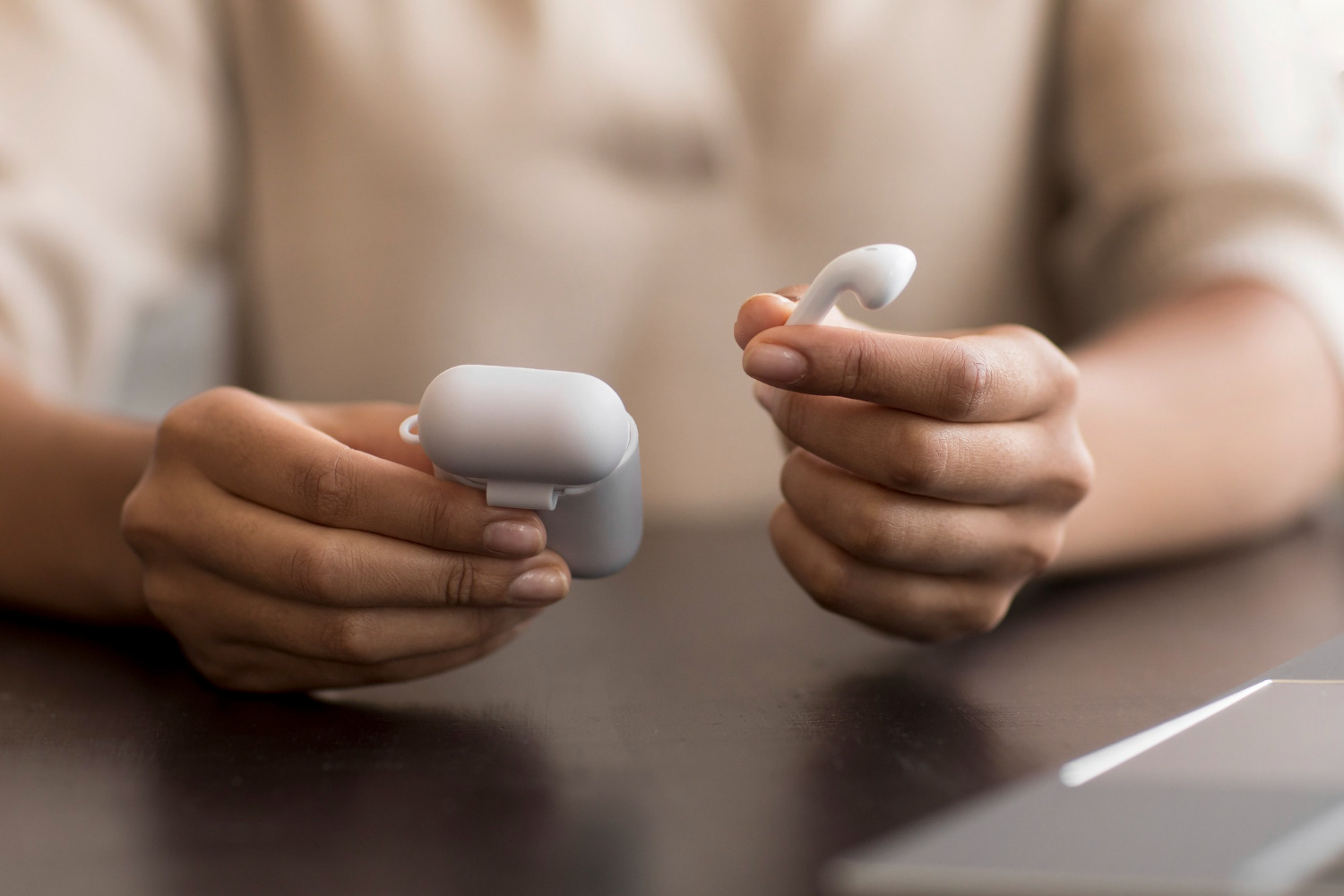
You have always wondered how do wireless earbuds work without any cables to connect to your phone or laptop. It’s almost magical – the sound passes through the air with ideal synchronization to your favorite song or podcast.
In fact, this magic is a blend of superior Bluetooth technology, microelectronics, and signal processing, all in devices that fit in your palm.
At Technogater, we are delving as deeply into the science of wireless audio as possible and explaining it in clear, professional language.
What Are Wireless Earbuds?
Wireless earbuds are mini earphones that receive audio signals using radio waves, eliminating the need for a wire. They enable you to enjoy music, make calls, or communicate with intelligent assistants without being constrained by cords.
The vast majority of current earbuds, such as Apple AirPods, Samsung Galaxy Buds, or Sony WF series, can be classified as true wireless earbuds, which implies that each earbud is an independent device not connected by a wire.
How Do Wireless Earbuds Work? – The Core Technology Explained
The question of how do wireless earbuds work can be answered in a single word: Bluetooth.
These miniature gadgets connect to your smartphone, tablet, or computer via Bluetooth radio waves. When you press the play button on your device, the sound is converted into digital signals and sent wirelessly. Then, the earbuds convert these digital signals back into sound.
It is a cycle that occurs in milliseconds, and it appears immediate to our ears.
The Bluetooth: The Wireless Connection Biggie.
The basis of wireless earbuds’ functionality is Bluetooth. It is a low-range wireless communication protocol that utilizes 2.4 GHz radio waves to transmit information between two devices.
The following is the mechanism of operation:
- Pairing: The Connection between the earbuds and your device is established through a secure pairing process, facilitated by a common digital code.
- Transmission: Your device transmits audio data that has been compressed using radio.
- Reception: A built-in antenna transmits the signal to the earbuds.
- Decoding: The data is processed by internal processors into audio, which can be played.
- Playback: Minute speakers convert the signal to clear and amplified sound.
The latest Bluetooth 5.3 technology offers a greater range, improved sound quality, and reduced power consumption, which is why current earbuds are so dependable.
Components Inside Wireless Earbuds
To learn about the operation of how do wireless earbuds work, it is essential to understand their components. Each earbud includes:
- Microchip & Processor: Processes Bluetooth and converts digital signals to audio.
- Battery: Typically a small Li-ion cell that lasts hours.
- Speakers (Drivers): Convert electrical energy into sound waves.
- Microphones: Record the voice of calls and orders.
- Antenna: Facilitates wireless.
- Sensors: Feel your touch, movement, or know when the earbuds are in place on your ears.
All these elements interact with one another in a space that is less than the size of your thumb.
Power and Battery Management
Since the devices operate on batteries, power efficiency is paramount in the case of wireless earbuds.
To understand the workings of wireless earbuds, it is essential to note that they contain miniature batteries that store energy. In most models, a charging case is also included, which can serve as both storage and a portable charger.
Energy management chips are guaranteed to:
- The transfer of power during the charging process is smooth.
- Auto Shut off when not in use.
- Standby efficiency with low power.
With improvements in lithium-polymer technology and fast-charging circuit boards, it is now possible to have up to 8-10 hours of continuous usage on a single charge.
How Sound Travels From Device to Earbud
This is the process behind the work of wireless earbuds in sound transmission terms:
- Encoding: The audio file is converted into a compressed format, such as SBC, AAC, or aptX, by the smartphone.
- Transmission: The audio information is transmitted wirelessly on Bluetooth frequencies.
- Decoding: This information is decoded by the earbuds’ chipset in real-time.
- Amplification: The amplifier is a small one that amplifies the signal.
- Output: The driver shakes, producing sound waves that pass through your ear canal.
There is a minimal latency (or delay between sound and video) when using low-latency codecs in modern earbuds.
Role of Microphones and Noise Cancellation
The earbuds contain microphones as well as devices used to minimize noise, not just for making calls.
There are two main types:
- Feedforward microphones: Hear what is on the outside.
- Feedback microphones: Determine the noise in your ear canal.
They work together to facilitate Active Noise Cancellation (ANC), where the unwanted sounds are cancelled with the help of anti-noise waves.
This is the primary functionality of the wireless earbuds, allowing you to concentrate on your music or phone calls in noisy conditions of daily use.
Pairing Process Explained
The handshake is the process that facilitates pairing. This is how it works technologically:
- When you are in a pairing mode, your earbuds transmit a Bluetooth signal.
- This signal is detected by your device, and connection authorization is demanded.
- Both gadgets save the digital addresses of each other once they are accepted, which makes them automatic to reconnect in the future.
There is also the possibility of using modern earbuds that can connect to multiple devices simultaneously, thanks to Bluetooth multipoint technology.

Common Wireless Earbud Technologies
Knowing the range of technologies at work here will make you understand how it is so easy to make how do wireless earbuds work:
- Bluetooth LE Audio: Offers greater bitrate efficiency and sound quality.
- aptX Adaptive / LDAC: Offers high-resolution audio streaming.
- Touch Sensors: Allow you to manage the playback with the touch of a few buttons.
- Voice Assistant Integration: Can be controlled using Siri, Alexa, or Google Assistant.
- Spatial Audio: Mimics surround sound to achieve the immersive experience.
Differences Between True Wireless and Regular Bluetooth Earbuds
Both of these are based on similar principles, but the true how do wireless earbuds work do not have any physical connection between the left and the right earbuds.
The true wireless ones are more portable, can be designed more flexibly, and have an individual battery in every earbud. Normal Bluetooth earphones, however, typically have a short cable connecting the two earpieces.
The situation with true wireless technology is that each earbud can be synced independently, which enhances the balance of sound and overall freedom of motion.
Challenges Engineers Face
The engineers who are developing how do wireless earbuds work are faced with several technical challenges:
- Harvesting in high-frequency bands.
- Audio is retained even when compressed.
- Without overheating, miniaturization.
- Limitations in battery size.
- There is a synchronization between the right and left earbuds.
Ongoing research on chip design and battery chemistry is contributing to overcoming these hurdles.
Benefits of Using Wireless Earbuds
This is why wireless earbuds are the choice of the entire world in terms of sound:
- Liberty to go about exercises and tours.
- Unique experience. No tangled wires.
- Fast connection and connectivity.
- Small size and convenient carrying.
- Intelligent functions include touch control, ANC, and water resistance.
The mechanism of action of how do wireless earbuds work is also useful in making you realize how innovative it takes to come up with such convenience.
How to Maximize Performance
In order to make the most of your earbuds:
- Keep them clean and dry.
- Regular updates to the firmware for improved performance.
- When not in use, keep them in the charging case.
- They should not be used in extreme temperatures.
- Repairing earbuds should be done in case of disconnections.
These habits will ensure the well-known audio quality and extended battery life.
Future of Wireless Earbud Technology
The history of wireless earbuds’ development is just beginning.
Upcoming trends include:
- Wireless noise cancellation with AI adaptability.
- Health sensors to check heart rate or temperature.
- Self-charging earbuds technology.
- Better codecs with lossless wireless audio.
- Immersive soundscapes of augmented reality.
Such inventions will continue to blur the boundary between technology and the human senses.

FAQs
1. How do wireless earbuds work without any wires?
Bluetooth radio waves are used to transmit audio signals between your device and the earbuds. A real-time signal encoded in tiny chips will decode and transform those signals into sound.
2. Do both earbuds receive signals separately?
Yes. Current true wireless earbuds transmit data to each earbud via a synchronized Bluetooth channel, providing balanced stereo sound —a crucial component of how do wireless earbuds work.
3. How do wireless earbuds stay connected?
They have a continuous Bluetooth connection. When one of the buds loses signal, the other assists in restoring it immediately to the other. That is how wireless earbuds perform seamlessly.
4. Can wireless earbuds work without Bluetooth?
Yes, in the vast majority of cases, it is not. Bluetooth. Nevertheless, there are also sophisticated models that rely on near-field magnetic induction (NFMI) for internal communication – another manifestation of how do wireless earbuds work.
5. How long do wireless earbuds last?
They have a charge that lasts 4 to 10 hours on average, depending on the model and features such as ANC. This is further enhanced by charging cases that take up to 24 hours (or even longer) to demonstrate the efficiency of wireless earbuds.
Final Thoughts
After learning about how do wireless earbuds work, it is now clear that these miniature gadgets are marvels of engineering. It is a combination of Bluetooth technology, high-tech microprocessors, and acoustics, which produces a wireless and smooth sound.
We believe technology like this is the future of personal audio at Technogater: smart, wireless, and comfortable. Whether you are listening to music wirelessly, receiving calls, or being in a virtual reality, wireless earbuds are the key to the next level of listening experiences.
